
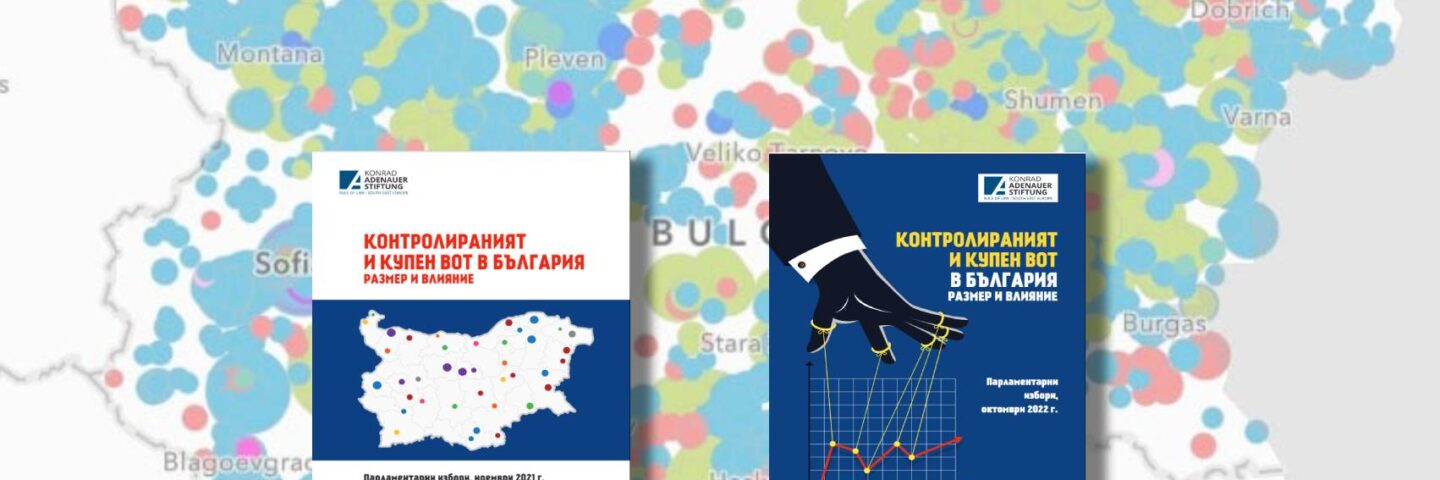
Controlled and bought votes in Bulgaria. Size and influence
The analysis shows what happened in 1,738 high-risk polling stations, which ACF experts identified after statistically analyzing the results of all elections between 2013 and 2021, as well as which new polling stations are at risk.
Polling stations with a higher risk of vote buying and control are identified on the basis of indicators such as unusually high voter turnout, unusually high results for the winning party in the polling station, sharp deviations in voter turnout, and a sharp increase or decrease in support for a particular political party.
You can download the analysis here.
Video with the main results of the analysis here.
A file with the coordinates of the sections can be found here.
The analysis was created with the support of the Konrad Adenauer Foundation under the Rule of Law for Southeast Europe Program.
Key findings from the analysis
The trend of risk sections registering a more pronounced decline in voter turnout than other sections, as observed in the parliamentary elections in July 2021, continues. In some places, this trend is more noticeable, but there are regions and municipalities that show deviations from the overall picture.
The largest decline in voter turnout in high-risk polling stations was observed in the Stara Zagora, Varna, Burgas, and Sliven multi-member constituencies.
In the 13th MIR Pazardzhik, turnout in at-risk polling stations is increasing.
In the municipalities of Velingrad, Levski, and Valchedram, turnout in at-risk polling stations is increasing.
In the municipalities of Burgas and Ruse, the decline in activity in the at-risk sections is significantly more pronounced than the average decline in activity in the municipality.
In other municipalities where the share of potentially bought and controlled votes is significant, such as Kotel, Tervel, Hitrino, Kirkovo, and Sungurlare, voter turnout in the at-risk polling stations is declining at a rate similar to the average decline in the municipality.
The percentage of municipalities where the share of potentially bought or controlled votes in the total vote in the municipality is below 1% has increased significantly.
The Movement for Rights and Freedoms retains its leading position in terms of the share of votes received in at-risk sections, with a relatively small loss in at-risk sections compared to July. GERB remains in second place in terms of this indicator, but they have reported significant losses in the risky sections. The next positions in terms of the share of the vote at risk are held by BSP, the Continue the Change party, and Democratic Bulgaria.
The most significant share of votes for parties at risk is for the Movement for Rights and Freedoms (MRF), the National Union of the Right, and the BSP, which are in the lead in terms of the share of votes for the party cast in risky sections. GERB, ITN, and the Continue the Change party have a lower percentage in this indicator.
In 15 localities, the share of votes cast in mobile ballot boxes is over 25%, which indicates a potential new mechanism for controlling the vote. However, the effect of such schemes on the results of the parliamentary elections is insignificant.