
The Anti-Corruption Commission has illegally classified all its decisions on the confiscation of property
The Anti-Corruption Commission (CAFIAP) has declared all its decisions to initiate proceedings for confiscating illegally acquired property as an official secret. The decision was made in 2018 by the then-director of CAFIAP, Plamen Georgiev, and is still in force. The order violates the law, which does not allow information to be declared an official secret for more than six months.
The news became clear at a hearing within the court case filed by the Anti-Corruption Fund (ACF) because the ACF was denied access to the Commission’s decisions on filing a claim for confiscating illegally acquired property from 2018 until now. The – Sofia City Administrative Court is considering the case.
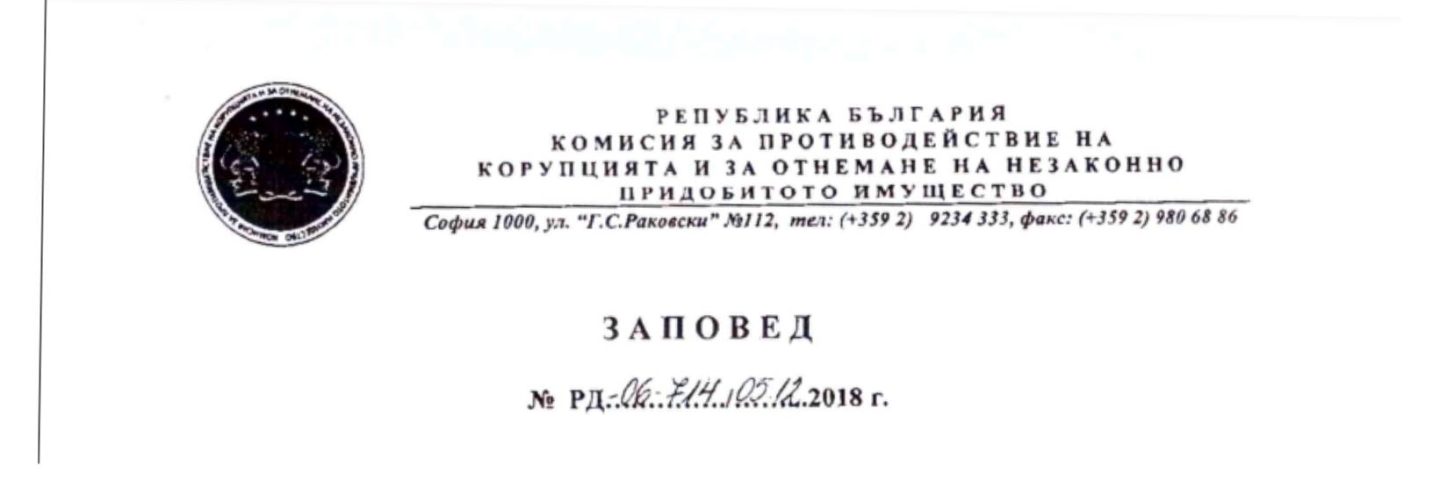
The representatives of CAFIAP substantiate their refusal with an order adopted in 2018 by the then chairman of CAFIAP, Plamen Georgiev, who resigned in 2019 after the “Apartmentgate” scandal, which began with revelations by ACF and Free Europe. According to the order, all decisions of the CAFIAP to initiate proceedings for confiscating illegally acquired property are official secrets and cannot be disclosed.
“Adopting such an order is a scandalous limitation of the public’s right to be informed about the activities of one of the key anti-corruption bodies in the state. This order was also adopted in clear violation of the law,” states Daniela Peneva, legal advisor at the Anti-Corruption Fund.
Confiscating illegally acquired property is the most voluminous field of action of the CAFIAP in which the most significant number of its employees are employed, and the largest number of acts are issued, many times more than in other areas of the Commission’s work.
“Plamen Georgiev’s order makes this activity completely secret. The public cannot be informed about what checks the Commission has carried out, what analysis of the facts it has done and what legal conclusions it has reached to decide to open a case.”
This order also directly contradicts the Law on the Protection of Classified Information. According to it, for information to be classified as an “official secret,” unregulated access must harm the state or another legally protected interest. The period for which access to an official secret can be denied is limited to 6 months. These legal prerequisites indicate that the purpose of the law is that the restriction of access to information is always specific, taking into account the particularities of each case and temporary (limited in time). Contrary to the law’s purpose, Plamen Georgiev’s order denies access to all issued and future decisions of the CAFIAP once and for all.
According to the ACF experts, the information about the decisions of CAFIAP in no way harms the state’s interests. On the contrary, it allows the public to form an opinion on the facts and conclusions based on which the CAFIAP initiates proceedings for confiscating citizens’ property. By its very nature, this is public information that cannot be classified, especially indefinitely. Possible arguments for protecting personal data cannot be accepted insofar as, in such cases, the law allows their deletion. In addition, it is the personal data of the affected persons and information about their property that is subject to publication in the State Gazette, immediately after the initiation of the case, at the request of CAFIAP.
“This is an administrative arbitrariness, which can become a precedent: the institutions could be tempted to follow the CAFIAP’s example, declare all their activity an official secret and hide it from the public,” states Boyko Stankushev, director of ACF.
“We await the court’s decision in this case and hope it will protect the public’s right to be adequately informed about the activities of key state institutions.”