
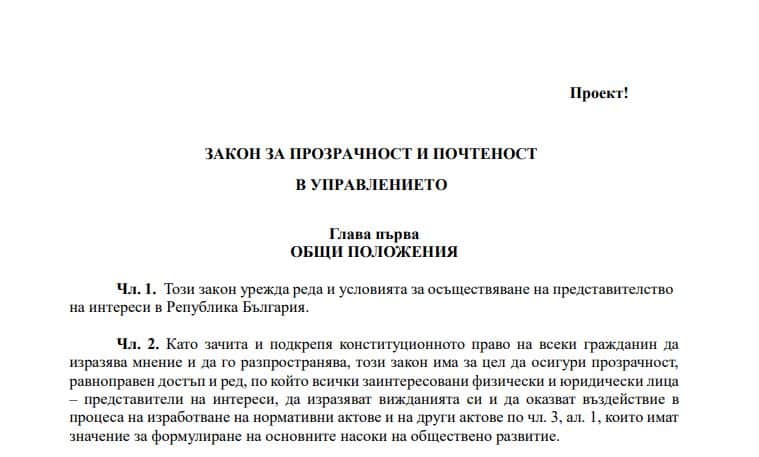
Opinion on the Draft Law on Transparency and Integrity in Governance
Opinion on the Draft Law on Transparency and Integrity in Governance
To
Andrey Yankulov
Minister of Justice, Republic of Bulgaria
Regarding: Public Consultation on the Draft Law on Transparency and Integrity in Governance
Dear Minister,
The undersigned civil society organizations – Bulgarian Institute for Legal Initiatives (BILI), Center for the Study of Democracy (CSD), Access to Information Programme, Bulgarian Helsinki Committee, Anti-Corruption Fund Foundation (ACF), Workshop for Civic Initiatives Foundation, and Institute for Market Economics (IME) are working consistently to strengthen the rule of law in Bulgaria, promote transparent and honest governance, encourage civic participation, and support a favorable business environment.
Representatives of BILI, CSD and the Access to Information Programme are members of the working group, under the Ministry of Justice, tasked with drafting the legal texts regulating lobbying (interest representation).
The working group to create a Concept for the Regulation of Lobbying Activities and, subsequently, the draft law on transparency and integrity in governance, was established in 2023. The commitment to such regulatory measures is part of the Governance Programme of the Republic of Bulgaria for the period 2025 – 2029, a measure under the Recovery and Resilience Plan (Q4/2023) and a commitment by Bulgaria as it works to join the Organisation for Economic Cooperation and Development. Operating within a dynamic political environment with frequent changes in political leadership, the working group provided a platform to discuss various views and opinions concerning the role and functions of public bodies in ensuring greater transparency and integrity in governance.
As civic society organisations, we support the goals of greater transparency in public decision-making and mechanisms to limit undue influence.
At the same time, the draft law, as it currently stands, creates tangible risks to the freedom of expression, freedom of association and the right to public participation granted to citizens and organisations. Some of the envisioned mechanisms have been formulated too broadly, with unclear criteria and high sanctions, which will undoubtedly have a chilling effect on civic activity, narrowing the civic space. The draft law that has been submitted for public discussion contains mechanisms which contradict the Bulgarian Constitution as well as our country’s obligations under international human rights treaties.
In light of the above, OUR OPINION IS THAT THE DRAFT TABLED ON 29 JANUARY 2026 SHOULD BE WITHDRAWN AND THOROUGHLY REVISED.
We present the following arguments:
Ι. THE TITLE OF THE DRAFT LAW IS MISLEADING AND UNDERMINES DEMOCRACY AND THE RULE OF LAW
Following prolonged deliberations of the concept of a law on lobbying activities and the draft law, the experts representing civic society in the working groups within the Ministry of Justice adopted an almost unanimous position that the term lobbying is, on the one hand, unknown, on the other, has a negative connotation within the national discourse, and should be exchanged with a more appropriate one. Even as the experts of the Ministry of Justice rightly took note of this important aspect, the title Law on Transparency and Integrity in Governance is misleading and contradicts basic principles established in the Constitution of the Republic of Bulgaria. Article 4, paragraph 1 of the Constitution states that power is granted by the people, which obliges all elected and appointed public bodies to adhere to the principles of transparency and accountability.
These obligations of state authorities are contrary to the right of everyone to seek, receive, and disseminate information, guaranteed by Article 41, paragraph 1 of the Constitution and further established by the provisions of the Access to Public Information Act. Selecting such a title of a draft law which creates obligations for civil society representatives while claiming the goal of achieving “transparency of governance” is a radical and absurd reversal of the roles of the entities bearing rights and obligations. The lack of consistency between the stated purpose of the law, the obligations it creates, and its title, leads to an internal contradiction, which is a significant violation of the requirement concerning the format of normative acts. The title of a law must reflect its essence, purpose, and content, rather than directly contradicting them. To accept the opposite would mean, for example, allowing the title Penal Code to be replaced with Code for the Promotion of Crime. We believe that the choice of such a title leads to the unconstitutionality of the proposed draft law.
It should be noted that these issues / discrepancies / violations are placed within the context of concerted attempts to limit basic rights and undermine the foundations of the democratic state, carried out by known and unknown political powers and other actors. This process has been ongoing not only in Bulgaria but also in other countries in Central and Eastern Europe. The title of the draft law is very similar to that of a recent legislative initiative in Hungary, which has a clear goal of limiting civic activity and civic participation in decision-making processes via new, censorship-like requirements for transparency imposed on the representatives of civic society organisations. The rights to freedom of speech and public participation in decision-making form the foundation of the term ‘democratic society”. Limiting those rights without providing any motives for doing so is an attack against the very principles of democracy and the rule of law. Therefore, what should also be under review is the possible impact that such a misleading title could have on the implementation of the law and the attitudes towards it.
II. POOR CONCEPTUAL CHOICE OF REGULATORY MODEL
The draft law adopts a holistic, all-encompassing approach to regulating lobbying (interest representation). This approach adopts a broad definition of interest representation, introduces a mandatory central register, creates a sanctions regime, and includes a wide range of institutions and legal and natural persons. Such a model envisions comprehensive and systemic engagement in a sphere that, so far, has not been regulated by a separate, thorough legislative text. It is precisely here that the first conceptual issue lies – the regulation features a comprehensive set of sweeping measures introduced without any pre-existing institutional experience, without any administrative experience and without sufficient empirical analysis of the phenomenon’s scope and manifestations. The conceptual documents presented so far lack a detailed analysis outlining the spheres most affected by non-transparent lobbying, the volume of professional lobbying, and the reasons for the past failures to regulate the issue. On numerous occasions, both within the working group and in public statements, BILI, CSD and the Access to Information Programme have noted that the proposal fails to define clearly the scope and to point out specific normative solutions. Considering the absence of such a preliminary analysis, the choice of a comprehensive legislative model creates risks of unequal treatment in transparency requirements, imbalances in the repressive functions of the state, raises reasonable doubts about meeting the stated goal of achieving greater transparency and integrity in governance, and could seriously undermine civic participation.
At the same time, the international standards referred to in the explanatory memorandum to the draft law do not require the adoption of a separate, comprehensive law with a broad sanctions regime. In successive opinions, we have expressed the position that most countries apply a combination of regulatory provisions and voluntary self-regulation schemes, rather than a uniform, centralised, and mandatory regulatory framework. The European Union has no binding regulatory requirements for the regulation of lobbying.
The OECD Recommendation on Transparency and Integrity in Lobbying and Influence focuses primarily on professional lobbying and transparency in access to public office, while the GRECO recommendations emphasise rules of conduct for persons holding high public office, including disclosure of their contacts with third parties. None of these standards requires the simultaneous introduction of a centralised register, mandatory registration of a wide range of entities, and a sanctions regime affecting a significant part of civic participation. Therefore, the chosen model is the result of an internal political choice rather than an inevitable external obligation.
What is particularly problematic is the conceptual focus of the draft. Instead of placing the main emphasis on the transparency of public authorities and the conduct of individuals exercising public functions, the adopted model places a significant part of the regulatory burden on entities exercising their right to public participation and representing public interests. The draft text imposes disproportionately more obligations and penalties on citizens than on public institutions. Thus, the proposed law risks becoming an instrument for controlling public participation rather than a mechanism for bringing transparency to access to power. In a democratic context, it is precisely the transparency of institutions and their contacts that should be the primary object of regulation.
Against this backdrop, a cascading, incremental approach would be more appropriate for the Bulgarian context. Instead of simultaneously regulating all forms of communication with a wide range of bodies, the legislator could start with the core of the problem — bringing greater transparency to efforts to influence the legislative process. This means obliging members of parliament and members of political cabinets to disclose their meetings with various entities, introducing a legislative imprint on every bill, and ensuring full transparency concerning external expert consultations and contracts.
Similar solutions have been proposed in our previous opinions, including creating a register for the National Assembly and gradually expanding it.
The incremental model allows for the accumulation of practical experience, institutional learning, and actual impact assessment before expanding the regime. It reduces the risk of over-regulation and undermining civic participation, while simultaneously focusing on the riskiest area: non-transparent access to legislative power. In the context of critically low trust in institutions and challenges for civil society organisations, such a phased approach would be compatible with both international standards and the principle of proportionality. The gradual introduction of transparency requirements, starting with the legislative process, would be a more balanced and adequate response to safeguard the public interest, while reducing the risk of imbalance and disproportionate interference in civic participation.
III. LACK OF COMPATIBILITY WITH THE CONSTITUTION OF THE REPUBLIC OF BULGARIA AND INTERNATIONAL TREATIES
The proposed draft Law on Transparency and Integrity in Governance raises serious questions about its compatibility with the Constitution of the Republic of Bulgaria, the case law of the Constitutional Court, and the standards of the European Union and the European Convention on Human Rights.
Firstly, Articles 39, 40, and 41 of the Constitution guarantee freedom of expression and the right to seek, receive, and disseminate information. Article 45 explicitly enshrines the right of citizens to submit proposals, complaints, and petitions to state authorities. Together, these provisions form the core of constitutionally protected communication rights and citizen participation in the decision-making process. In its practice, the Constitutional Court has consistently held that restrictions on fundamental rights are permissible only when there is a legitimate aim, necessity, and proportionality, and when restrictions do not affect the essence of said rights. The introduction of a mandatory registration regime, combined with sanctions, as a prerequisite for participation in communication with the authorities, constitutes a de facto administrative filter on the exercise of political speech. When the exercise of the right to public participation is made contingent on prior registration and punishable by sanctions for non-compliance, the result approximates a licensing regime, which contradicts established standards of freedom of expression.
In Decision No. 7 of 4 June 1996 regarding Case No. 1/1996, the court held that freedom of speech is a fundamental condition for the existence of a democratic society, and that restrictions on it should be interpreted narrowly. The Constitutional Court’s case law clearly points out that restrictions on fundamental rights are permissible only if they are established by law, pursue a legitimate aim, and are proportionate. Subjecting communication with the authorities for the purpose of influencing the legislative process to a registration regime and linking it to sanctions constitutes an interference at the core of communication rights. The legislator cannot, through formal requirements, create obstacles that essentially render the exercise of the right meaningless. It is precisely the risk of making registration a precondition for the legitimacy of public participation that raises doubts about disproportionate interference. Insofar as such interference may prove to be not only disproportionate but also represent a specific form of censorship on the right of citizens and civic organisations to seek, receive, and disseminate information and to freely express their opinions on matters of public importance, allowing such interference should be assessed as a very serious risk and an obstruction to the exercise of fundamental rights.
Secondly, Article 44 of the Constitution guarantees freedom of association. Imposing a special registration regime on organisations that advocate or represent interests imposes additional conditions on the exercise of an already recognised right. The Constitutional Court accepts that the state cannot, through secondary legislation, introduce restrictions that essentially impede or render meaningless freedom of association. When the requirement for registration in a public register is accompanied by requirements for the publication of sensitive information, including information on financing and contacts, the question of compatibility with Article 32 of the Constitution also arises. It should be stipulated clearly which information on financing and contacts needs to be made public.
The case law of the Court of Justice of the European Union and the European Court of Human Rights views restrictions on civil society organisations particularly strictly, especially when these restrictions have a deterrent or stigmatising effect. For example, the judgment of the Court of Justice of the European Union (Grand Chamber) in Case C-78/18 (Commission v Hungary) and the judgement of the European Court of Human Rights in the Case of Ecodefence and Others v. Russia, clearly state that mandatory registration regimes that single out foreign-funded organisations, or aim to stigmatise them, are inadmissible. Although the proposed bill does not formally use the term “foreign agent,” its structure — a public register, detailed disclosure of funding, sanctions, and potentially negative public labeling — creates a similar risk of stigmatisation, especially in a context where attempts have already been made to introduce a law on “foreign agents”. The opinion of the Economic and Social Council of the Republic of Bulgaria from November 2024 concerning this draft text emphasises that such regimes can increase the pressure on civic space and create conditions for arbitrariness. In an environment that is hostile for the non-governmental sector, such a regulation could have a chilling effect, limiting civic participation and even leading to the persecution of citizens or organizations critical of the authorities.
The draft law creates significant risks of conflict with the constitutionally guaranteed freedoms of expression, association, and participation in government. By introducing a mandatory registration and sanctioning regime, it brings the legal framework closer to models that have already been criticized by constitutional jurisdictions and European courts as incompatible with the principles of the rule of law and democratic societies. The risk of de facto introduction of a ‘foreign agents’ regime is not hypothetical, but stems from the very logic of publicly designating and sanctioning certain forms of civic participation.
IV. PROBLEMS IN DEFINING THE SUBJECT, OBJECT, AND PURPOSE OF INTEREST REPRESENTATION (LOBBYING)
The draft law defines the object of interest representation (Art. 5) as the public officials and bodies receiving information. When these recipients are broadly formulated, and not limited to key high-level positions with considerable powers, the application of the law would be focused mainly on legitimate forms of public participation in governance of which the public is already informed, albeit, on occasion, sparingly and formalistically. It turns out that, in effect, the law would not provide greater transparency about the channels bearing the highest risks of illegitimate influence. The draft fails to stipulate any rules of conduct for public officials and institutions, not even basic requirements for accountability and transparency about meetings with parties representing interests, while at the same time creating administrative hurdles obstructing civic participation.
In terms of the public interest, defining the “object” of lobbying means, to the greatest extent possible, ensuring transparency of influence through objective, regular, substantive, and comprehensive disclosure of the meetings of public authorities, especially in the legislative process and the executive branch. The wording of Art. 18(2), which provides that the register shall exchange data with the websites of the authorities on the persons referred to in Art. 5 is unclear. What is the purpose of this exchange and will it lead to centralised information and verification of the meetings held by the objects of lobbying?
The draft law changes the logic concerning the source of information about contacts between on the one hand, natural and legal persons and, on the other, those exercising public authority. It treats the ‘object’ primarily as a criterion for the obligations of external subjects (Art. 3(1) in conjunction with Art. 9 and Art. 10 and the requirements for entering information in the Transparency Register in Art. 13 – 15). A bill that aims to create a transparent government model should focus primarily on the obligations and standards for public institutions on publishing information on their interactions and communication with external entities. The bill does not contain any provisions that require those it is addressed to (Art. 5) to disclose their advisors or any consulting contracts they themselves may have concluded with external entities.
Lobbying is framed by its definition, which determines what communication is treated as ‘representation of interests’ (Art. 3, paragraphs 1 & 2), and what is not. The definition is excessively broad, including “any oral or written communication” for the purpose of exerting influence, and does not make a clear distinction between political consulting, advocacy in the public interest, and lobbying for private interests.
Defined in this way, the notion of lobbying contains three groups of defects.
First, the definition leaves room for uncertainty. Entities cannot reasonably assess whether they fall under the regime. The draft simultaneously uses the terms ‘communication’ and ‘contact’ (see, for example, the additional provision), but there is no definition of ‘contact’ and it is unclear what registration and reporting obligations lobbying entities have. This creates a risk of arbitrary application of sanctions.
Secondly, there is no differentiation between forms of political participation: for example, exercise of civic rights in the communication with institutions, civic advocacy — the work of organisations in support of public interests; representation of private interests — for example, lobbying for preferential conditions in sectors of the economy with the goal of maximising profits; political consultancy — providing expert opinions on public policies or the political process. The adoption of such a broad definition can also lead to contradictions with differentiating between active and passive influence peddling (Art 304 of the Penal Code) provided that the public prosecution acts in good faith and does investigate such crimes.
The broad definition creates the conditions for barriers which could obstruct the work of civic society organisations. Even without the introduction of terms such as ‘foreign agents’, a registration regime for civic activists creates opportunities to target them through stigmatisation and unfounded sanctions. In fact, the standards established by the OECD and the Council of Europe call for a broad definition which shall, nonetheless, be relevant to the national context and specifically exclude activities which do not constitute lobbying.
The lobbying entity is defined not only by the term ‘interest representative’ but by a combination of criteria: regularity, occupation, commercial nature, remuneration, number of contacts, etc. (Art. 13(1), in conjunction with an additional provision). The criterion for regularity is defined by a threshold of nine contacts over three months. Since there is no definition of ‘contact’ (e.g., whether these are direct meetings or written communication), the threshold thus defined is low. Advocacy work often involves multiple types and levels of communication with representatives of public institutions. The draft law correctly assumes that addressing a statement to more than one person counts as a single contact (e.g., sending statements, opinions, invitations, etc., to representatives of various institutions). However, natural and legal persons often emphasize different aspects or focus on different elements of what is essentially the same communication. In this sense, the proposed threshold may in many cases prove to be too low, as it would fail to account for various initiatives and requests and could be interpreted merely as a formality. By setting such a low threshold, the bill once again shifts the focus of the necessary regulation—from the professional lobbyist to the active participant.
The criterion related to ‘commercial nature’ also poses risks, as it can be interpreted broadly. Instead of focusing on individuals and legal entities operating primarily for profit, it once again shifts to any professional civil society organisation with a team and resources— precisely the organisations that work systematically, conduct analyses, and participate in public life extensively.
The third criterion — ‘remuneration’ — has also been defined widely and once again creates conditions for the regulatory burden to be directed solely at civic organisations. In civil society organisations, work is compensated through project funding or donations, but the pursued goal is in the public interest. If the law fails to make a clear distinction between receiving remuneration for lobbying on behalf of private interests and remuneration for activities in the public interest, the subject is again defined in a manner that includes the activities of civil society organisations by default.
Another major shortcoming of the draft law is the selective nature of the exceptions in Art. 13(3). When political parties, trade unions, employer organisations, media outlets, and religious communities are excluded, but civil society organisations serving the public interest are not protected by a clear presumption or a separate, more lenient regime, the scope becomes politically vulnerable. It remains unclear why employer organisations, trade unions, and religious communities and institutions are excluded from the definition of entities representing interests. In essence, these are also civil society structures that protect the interests of large groups of private and legal persons. Since they are excluded, it is logical to also exclude non-profit legal entities that carry out activities in the public interest.
V. INAPPROPRIATE AUTHORITY FOR MAINTAINING THE TRANSPARENCY REGISTER AND EXCESSIVE COLLECTION OF PERSONAL DATA
The draft law provides that the transparency register for natural persons shall collect names and personal identification numbers (or dates of birth for foreigners), contact information, areas of interest, and other data. For legal entities, representatives and persons who actually perform the representation are to be registered in addition to information about the ‘project’. However, the terms ‘project’, ‘entity’, ‘awarding entity’, ‘remuneration’ and ‘period’ have not been defined. The register is public, its interface is accessible to the public and in a machine-readable, open format.
The bill does not provide the necessary safeguards for the proportional collection of personal data. The public disclosure of personal identification numbers and contact information creates a risk of abuse, harassment, doxing, and fraud. For civic activists, this is a real danger, especially given the local political and social context, in which they are often the target of attacks by political figures and oligarchic circles. Every legislative act must be structured in such a way that it avoids the unnecessary publication of sensitive personal data, adhering strictly to the provisions of the EU’s General Data Protection Regulation. The proposed legal text lacks a clear differentiation between the elements pertaining to public and service information, as well as clear deadlines for data retention and erasure.
Article 19 provides that the National Audit Office shall establish and maintain the transparency register. The National Audit Office is a constitutionally established, independent institution that exercises control over the execution of the public budget and other public funds and activities in accordance with the National Audit Office Act and internationally recognised auditing standards. It conducts financial audits, compliance audits, performance audits, and specific audits. Its primary mandate is to ensure accountability and oversight of the management of public funds.
Maintaining a register of interest representatives under the draft law is not part of the audit functions of the National Audit Office. Administering such a register involves accepting declarations, conducting verifications, maintaining a public database, and applying sanctions — all of these being administrative and not supervisory functions. Tasking the National Audit Office with such inappropriate functions would undermine public confidence in its functioning as an independent auditor of public finances, which is of paramount importance to the institution’s effectiveness.
There is also a lack of alignment with international standards and best practices. The International Organization of Supreme Audit Institutions has established key principles to ensure the independence of supreme audit institutions (SAIs) through the Lima Declaration and the Mexico Declaration on SAI Independence. Among these is the principle that SAIs should not be involved in activities that could undermine their functional and institutional (organisational) independence or involve them in administrative and political processes beyond the scope of their oversight function. There are exceptions in international practice (currently, only Finland maintains such a system) where SAIs administer registers of representatives of private interests. Typically, these functions are assigned to independent ethics and transparency committees, parliamentary committees, or administrative bodies with oversight and registration functions.
Assigning the responsibility for maintaining the register to the President of the National Audit Office would create a conflict between the audit and regulatory functions. If the Court of Auditors simultaneously regulates and monitors the conduct of interest representatives and the institutions subject to their actions, and audits these same institutions and processes (e.g., the legislative process, budget transparency, public policies influenced by lobbying), this gives rise to a conflict of functions and a potential conflict of interest. The institution will find itself in a situation where it is itself a participant in the process that it must subsequently audit objectively. There is a risk that the neutrality of the National Audit Office could be compromised and that it could be perceived as a party to administrative or political processes. An additional argument is the fact that, through questionable amendments to the National Audit Office Act (amended, State Gazette, Issue 16 of 10 February, 2026), the audit offie acquired significant powers regarding the effort to counter corruption: verification and publication of declarations of incompatibility and of assets and interests of persons holding public office, as well as regarding conflicts of interest. These powers, together with the powers to maintain a transparency register, will create a legally enshrined conflict of functions and may be challenged. This will further exacerbate the already existing excessive concentration of powers in a single body whose primary function differs substantially from the objectives set forth in the draft law.
We have proposed specific ideas regarding the creation of a register in our previous opinions and statements. For example, a transparency register under the National Assembly, in which organisations or other individuals interested in engaging in lobbying would voluntarily register, and which would establish the rules for its maintenance, providing guidelines, etc., combined with the adoption of rules for ethical conduct; a transparency register maintained by the Registry Agency, with the Minister of Justice serving as the supervisory authority, and others. In the event of a revision of the draft law, we would provide a detailed justification for these proposals.
VI. SANCTIONS LACK PROPORTIONALITY
The draft law stipulates fines and financial penalties ranging from EUR 1,000 to EUR 2,500 for individuals and from EUR 2,500 to EUR 7,500 for legal entities who engage in lobbying activities but are not registered in the transparency register.
These penalties are high, especially for small civil society organisations, local initiatives, and informal civic groups. The combination of high, undifferentiated penalties and unclear criteria for mandatory registration is a classic examples of a mechanism exerting a chilling effect. It would lead to self-restraint in civic participation as a way of avoiding the risk of financial and material losses. Thus, in practice, the law turns out to be punitive, imposing serious financial penalties against the backdrop of broad definitions of ‘lobbying’ and ‘lobbying entity’. A far more appropriate option would be to adopt the model applied by European Union institutions which places the administrative burden on public officials and which penalises lobbying entities that lack registration with the lack of opportunity to meet with the relevant public authority.
VII. WEAK AND INCONCLUSIVE PRELIMINARY IMPACT ASSESSMENT
The preliminary impact assessment fails to fulfill its role as an objective and evidence-based tool for making informed legislative decisions. It suffers from internal contradictions, a lack of quantitative analysis, and a superficial treatment of key issues, including the administrative burden and the impact on fundamental rights.
First, there is an obvious internal contradiction regarding the administrative burden. The section on specific impacts states that, with regard to natural and legal persons, there is no impact on administrative costs. At the same time, Section 6.4 explicitly acknowledges that impacts leading to an increase in the administrative burden have been identified, but these are limited solely to an increase in the administrative burden on the National Audit Office, not on natural and legal persons. The bill introduces mandatory registration, periodic reporting and updating of data, registration of specific ‘projects’, as well as a penalty regime for non-compliance. The assessment itself defines the administrative burden as costs arising from obligations to provide information, registrations, and declarations, and the associated costs imposed on businesses, the civil sector, public authorities, and citizens to comply with a legal obligation to provide information to public authorities or private individuals regarding their activities or operations. It is precisely such obligations that are created by the draft. Therefore, the assertion that no additional administrative burdens are envisaged for natural and legal persons is factually unfounded and logically untenable.
The assessment acknowledges the budgetary costs associated with establishing and maintaining the register, but fails to account for the actual regulatory burden that will be placed on the obligated entities. Thus, the administrative burden is presented as a problem solely for the state budget, without analyzing the effect on the organisations and individuals who will have to comply with the new obligations.
Second, there is no substantive quantitative analysis (with the exception of an estimate of the expected increase in the budget of the National Audit Office in connection with its powers). The assessment explicitly states that calculating the administrative burden requires data on the number of obligated entities, the average salary, and the frequency of the relevant actions. However, it does not provide even an approximate estimate of the number of potentially affected entities, nor a calculation of the time required for registration and updating, nor a projection of the annual administrative burden for a single organisation. The assessment even acknowledges the limited information available for the purpose of calculating the burden, yet it nevertheless recommends adopting the draft legislation. This means that the burden has not been measured, but rather assumed.
Third, the assertion that the proposal has no impact on fundamental rights was made without any legal analysis. The impact on freedom of expression, freedom of association, or the right to participate in governance has not been examined. The same applies to the chilling effect of the registration regime and the proposed sanctions. Given that the law links communication with public authorities to registration and reporting obligations, such a categorical conclusion regarding the absence of an impact on fundamental rights is methodologically untenable.
At the same time, the SME test was conducted in a formalistic manner, without an analysis of the relative impact on small organisations, local initiatives, and limited administrative capacities. There is no assessment of the effect of the the new obligations on small civil society organisations with limited staff and resources, which would be forced to allocate a disproportionately large share of their budgets to administrative compliance efforts.
VIII. CONCLUSION AND PROPOSAL
In conclusion, we urge once again that the proposed draft law not be submitted for discussion to the Council of Ministers. At the discretion of the Minister of Justice, it should be returned to the working group to address the significant omissions and problems contained therein.
Bulgarian Institute for Legal Initiatives
Access to Information Programme
Center for the Study of Democracy
Anti-Corruption Fund Foundation
Bulgarian Helsinki Committee
Workshop for Civic Initiatives Foundation
Institute for Market Economics