
Ministry of Justice Report Confirms Suspicions of Criminal Manipulation of the Elections for Members of the Supreme Judicial Council
In July, the ACF sent a referral to the Prosecutor’s Office regarding suspected computer crimes committed during the electronic voting for members of the Supreme Judicial Council (SJC). The vote was held on 25-26 June 2022. So far, we have no information on whether the prosecution has initiated an investigation in response.
News of the manipulation of the electronic voting system first appeared in January 2023, in an article by the weekly Capital. The article quoted the findings of a technical report conducted during the legal proceedings initiated after three SJC candidates had filed complaints challenging the results of the vote. These complainants are the judges Atanas Atanasov, Vladimir Valkov and Tatyana Zhilova, as well as Judge Vladislava Tsarigradska from Lukovit, who had nominated a candidate for the council.
The technical report, which was admitted during the proceedings without being challenged, had identified “various anomalies” in the use of the e-voting system: multiple votes being cast from the same IP address; IP addresses from which votes were cast dozens of times; consecutive casting of votes with ballots belonging to different voters. In the most flagrant violation, around 200 votes were cast within three minutes on 25 June 2022 from a single IP address belonging to the Supreme Administrative Court (SAC). The votes were cast on a Saturday morning even though the system allows judges to vote from their mobile phones and home computers.
In February 2023, despite the allegations of substantial violations and vote rigging, a five-member joint panel of judges from the Supreme Court of Cassation (SCC) and the Supreme Administrative Court (SAC) ruled that “the election of the six members of the SJC from the judicial quota is legal and valid and the uncovered violations could not have compromised the vote”. Specifically concerning the “anomalies” described in the technical report, the joint panel held that the multiple votes submitted from the same IP address (belonging to SAC) meant that multiple judges simply chose to exercise their right to vote from their official computers. The judges had been located in the courthouse and their votes were counted as cast from the single IP address of the court.
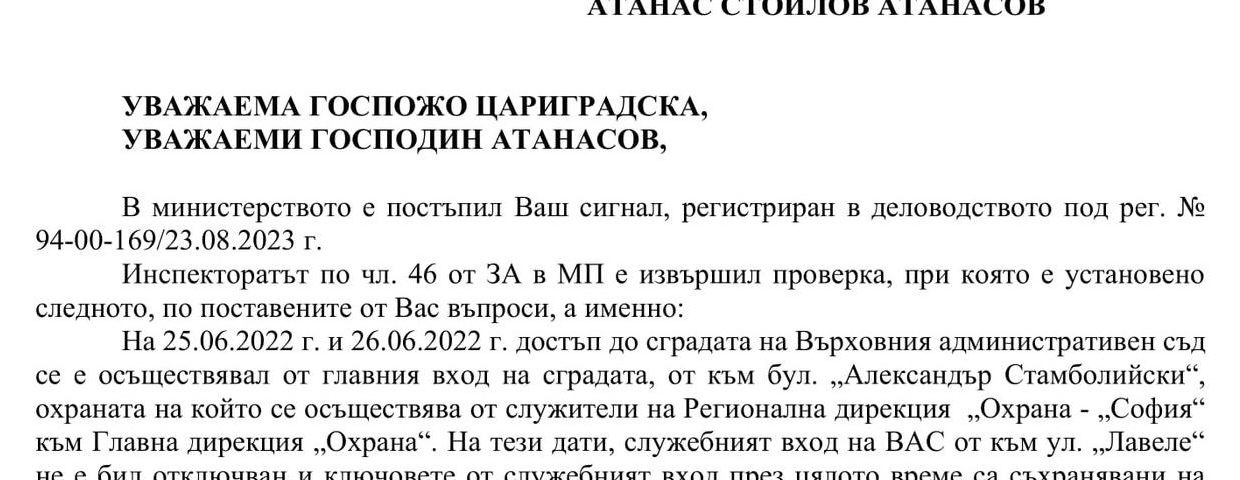
However, a response by the Ministry of Justice (MoJ) to questions by the judges Atanasov and Tsarigradska concerning the number of judges present in the SAC building during the election days strongly contradicts the joint panel’s version. The ministry, via its General Directorate of Security, is responsible for providing security in all court buildings.
According to the Inspectorate of the MoJ, on 25 June 2022 (Saturday) and 26 June 2022 (Sunday), the SAC building was only accessible through the main entrance (the service entrance had been locked). The details of all visitors were recorded in a special book, as per the rules for access to court buildings during non-working hours. On 25 June, only 19 people were logged in as having visited the SAC building. Of those 19 visitors, 13 were judges. On 26 June, a total of 21 people were registered, including 15 judges.
Thus, the “anomaly”, established by the technical expertise of hundreds of votes being cast on the morning of 25 June from the SAC building, remains without any logical explanation other than criminal manipulation of elections.
The ACF will refer this new information to the Sofia City Prosecutor’s Office, although we are convinced that, even with the minimum degree of effort, the competent authorities themselves should have become aware of it long ago.