
Prosecutor Claims Investigation of Embezzlement of Public Funds Compromised; Supreme Court of Cassation and Public Prosecution Turn a Blind Eye
In November 2023, Prosecutor Ivaylo Zanev from the Sofia City Prosecutor’s Office was removed from the case, publicly known as Hemusgate, just as he was about to lodge a 400-page indictment in court.
Subsequently, Zanev appealed his removal at all levels within the Prosecutor’s Office of the Republic of Bulgaria, even filing a report about crimes possibly committed by acting Prosecutor General Borislav Sarafov and other prosecutors in the context of the effort to silence him. The criminal justice system has failed to act, and Zanev’s draft indictment never reached the court.
This is a textbook example which shows that not only is the public prosecution failing in key investigations of large-scale corruption, but also public institutions remain deaf and blind to reports about wrongdoing by high-ranking public officials.
We believe that the public deserves full transparency in this case. This is why, today, we are disclosing the information available to us regarding how the Supreme Court of Cassation and the Sofia City Prosecutor’s Office handled Prosecutor Zanev’s reports, in which high-ranking prosecutors are implicated. At a later stage, we will also disclose what Zanev uncovered during his investigation,” said Andey Yankulov, senior legal expert at the Anti-Corruption Fund Foundation (ACF).
In October 2023, Zanev concluded work on a draft indictment of nine suspects involved in a scheme to steal and launder some BGN 55 million. The funds were transferred to the Road Infrastructure Agency by the Ministry of Regional Development and Public Works. The agency then made advance payments to the public company Avtomagistrali EAD, which, in turn, reallocated the funds to private companies on the basis of in-house tendering procedures. A large share of the money was then withdrawn in cash, disappearing without a trace.
A month later, as the indictment was about to be lodged in court, Zanev and the two other prosecutors leading the investigation were suddenly dismissed from the case. The decision was made by Emilia Rusinova[1], then a deputy appellate prosecutor at the Sofia City Prosecutor’s Office. Rusinova, who is now in charge of the Sofia City Prosecutor’s Office, has been implicated in ACF’s investigation The Eight Dwarfs. Rusinova is said to have regularly accepted money in exchange of doing favours for Petyo Petrov “The Euro”, the leader of a criminal network for influence over the judiciary.
Zanev and the other two prosecutors appealed their removal from the case; however, their arguments were dismissed by a prosecutor from the Supreme Cassation Prosecutor’s Office and by the Deputy Prosecutor General Maria Pavlova.
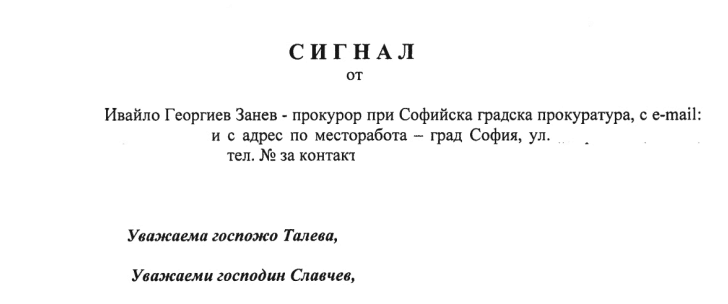
On 6 November 2024, Ivaylo Zanev filed a report to Daniela Taleva, the special prosecutor in charge of investigating the Prosecutor General and his deputies, copying the chairperson of the Commission for the Counteracting of Corruption. In the report, Zanev called for an inquiry into possible wrongdoing – bribery or crimes against justice – by the acting Prosecutor General and/or prosecutors from the Supreme Cassation Prosecutor’s Office, the Sofia Appellate Prosecutor’s Office and the Sofia City Prosecutor’s Office related to their oversight of the Hemusgate investigation.
In the report, Zanev listed procedural actions linked to the investigation. After he and his two colleagues were dismissed from the case, their replacements terminated the proceedings against many of the suspects. Those prosecutors were subsequently promoted. According to Zanev’s report, the actions of the new investigative team confirm his suspicions that the reason he was removed from the case was “to tamper with the criminal proceedings involving some of the suspects and some of the committed crimes, to delay as much as possible lodging the indictment in court and to file charges only against those suspects who had lower ranks within the scheme”.
“The fact that the report was filed by a prosecutor with in-depth and specific knowledge, not only of the investigation, but also of the ongoing practices within the public prosecution, calls for a significant institutional reaction. It is particularly important that Zanev filed an official report against the Prosecutor General – an unprecedented act within the strongly hierarchical structure of the public prosecution,” said Andrey Yankulov.
The recipients of the report refused to act. On 30 January 2025, Lada Paunova, Deputy Chairperson of the Supreme Court of Cassation, on grounds claiming lack of evidence implicating acting Prosecutor General Borislav Sarafov, forwarded Zanev’s report to the Sofia City Prosecutor’s Office instead of the Special Prosecutor. While it took Paunova three months to conclude that Zanev’s claims were unsubstantiated, prosecutor Yordan Petrov from the Sofia City Prosecutor’s Office, then handling proceedings concerning suspicions of wrongdoing by magistrates, reached the same conclusion within two days. According to Petrov, Zanev’s report consisted of “suspicions, insinuations and assumptions”.
“For an outside observer, it is difficult to tell with certainty whether the criminal proceedings into possible misappropriation of funds allocated for the expansion of the Hemus highway have been compromised. It should be noted, however, that there are serious indicators pointing to this,” said Yankulov. “For example, the prosecutors working on the case were dismissed shortly after completing their investigation, the charges against some of the suspects were dropped, and the new prosecutors working on the case were subsequently promoted.”
The criminal proceedings have since stalled, although their pre-trial stage was concluded in 2023. It was only in June 2025 when authorities announced that the proceedings would be split – a procedural approach frequently used to undermine sensitive investigations – and that some of the charges would be dropped.
“The public interest requires full transparency about this case as it concerns not just the fact that substantial public funds, allocated for expanding the Hemus highway, have been misappropriated, but also the manner in which the criminal justice system handles important investigations,” said Boyko Stankushev, director of the ACF.
Next, ACF will release the contents of the draft indictment, which never reached the court.
[1] https://bird.bg/hemusgate-rusinova/
Documents
Постановление №779 от 07.02.2025