
How BGN 54M for the Construction of Hemus Highway Ended up in a Warehouse near Blagoevgrad and Why the Perpetrators Were Never Charged
In the autumn of 2023, the Sofia City Prosecutor’s Office was about to file charges against the top managers of three large road construction companies suspected of organising and running a criminal group which had appropriated BGN 54 mln. of public funds allocated for the expansion of the Hemus Highway.
As the Anti-Corruption Fund Foundation (ACF) has already disclosed, the indictment was never lodged in court, and the public prosecutors who had worked on the investigation were subsequently reassigned.
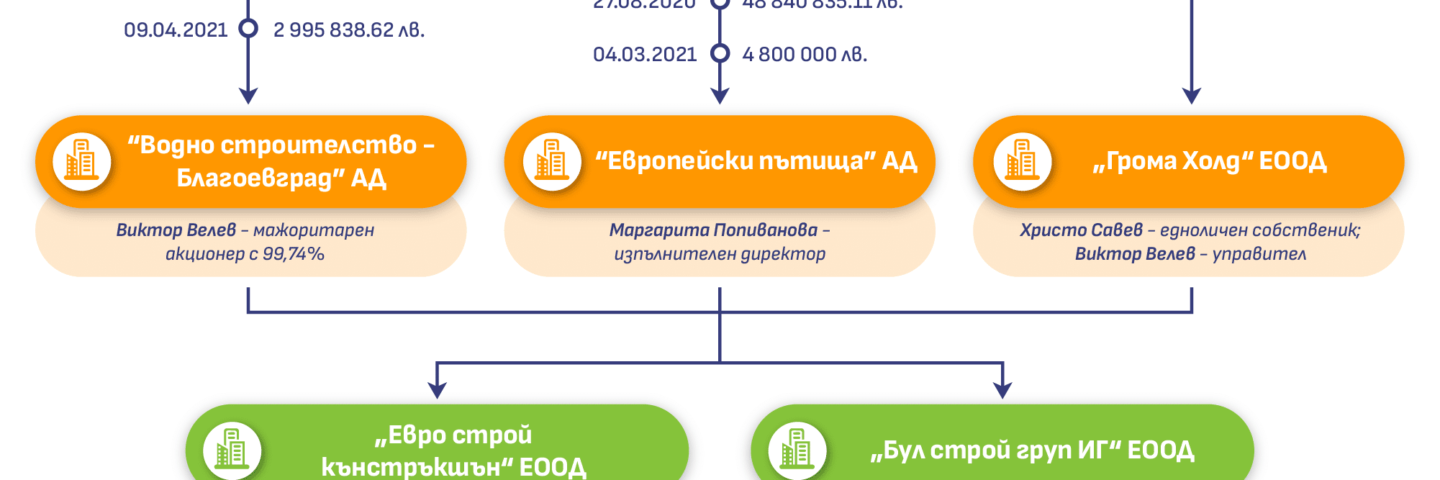
Today, ACF is publishing the draft indictment prepared by Ivaylo Zanev, a prosecutor at the Sofia City Prosecutor’s Office. Among the nine defendants is Hristo Savev, owner of Groma Hold, who was about to be charged with establishing and managing the group. Groma Hold’s director, Viktor Velev, and Margarita Popivanova, executive director of Evropeiski Patishta, were also about to be charged with managing the criminal group.
The draft indictment also described how the funds were diverted through a network of shell companies. From 18 June 2020 to 8 September 2021, members of the crime group withdrew large amounts of cash from the shell companies’ accounts via 66 transactions. The cash was then transported to a warehouse near the village of Zelendol in Blagoevgrad Municipality. The owner of the facility was the company Vodno Stroitelstvo – Blagoevgrad (in February 2024, the company was rebranded as Eterna Construction), where Velev is the majority shareholder. What happened with the money afterwards remains unknown.
“The draft indictment is not an official document. However, it has great significance because it shows that, for a limited period of time and at least among some prosecutors, there was a willingness to investigate one of the most scandalous recent examples of large-scale misappropriation in the road construction sector,” said Andrey Yankulov, senior legal expert at the ACF.
The scandal surrounding the plans to expand Hemus Highway broke out in 2021 when, following an audit by the Bulgarian National Audit Office, it emerged that the Road Infrastructure Agency had awarded contracts worth nearly BGN 4 billion to the state-owned company, Avtomagistrali, without a competitive tender process. In turn, Avtomagistrali awarded the work to private companies, thus violating the Public Procurement Act. In November that year, the Ministry of Interior announced that it was investigating the case. The investigation reached a court phase with a sole defendant – Borislav Kolev. Further information about the proceedings has not been made available; however, Kolev is mentioned as a member of the organised crime group in Zanev’s draft indictment.
How much money have the private companies received?
According to the draft indictment, from June 2020 to May 2021, Avtomagistrali made contractual payments worth nearly BGN 343 million to Evropeiski Patishta. Almost half of the total amount was advance payments for work, which has not been completed to this day, supporting the Hemus Highway expansion project:
– On 11 June 2020, Evropeiski Patishta received nearly BGN 95.9 million under a contract to deliver construction materials for works on Lot 6 of Hemus Highway. The payment represents 86% of the contract value.
– On 27 August 2020, the company received BGN 48.8 million under a contract to deliver construction materials for Lot 7.1 of the highway.
Also on 11 June 2020, a large advance payment of more than BGN 84 million was issued to Vodno Stroitelstvo – Blagoevgrad. The contract, which was at 86%, was for Lot 5 of the highway.
According to the draft indictment, the BGN 54 million that that group planned to appropriate, would be in the form of hidden profits generated through using less materials, as well as materials of lower quality than specified in the technical references of the project, by using less people and cutting salaries, social security contributions and VAT.
“The actual damage to the public budget is much larger than the BGN 54 million referred to in the draft indictment. The fact that, so far, there has been very little progress in expanding Hemus Highway raises suspicions about all transfers to the state-owned Avtomagistrali and on to the illegally-appointed subcontractors,” said Yankulov. “Not only was harm caused to the public budget, but also the economy of the northern part of Bulgaria as well as the lives and wellbeing of all drivers have been seriously affected.”
As evident from the draft indictment, only a week after Evropeiski Patishta and Vodno Stroitelstvo – Blagoevgrad received the first advance payments from Avtomagistrali, some of the funds were channeled through the web of shell companies and withdrawn in cash by Danail Georgiev, who had been specifically tasked with this job.
The funds were transferred to Bul Stroy Group IG and Euro Stroy Construction, two companies typically used as subcontractors by Vodno Stroitelstvo – Blagoevgrad and Evropeiski Patishta in projects managed by Road Infrastructure Agency and Avtomagistrali. In turn, the two subcontractors rediverted the money to four companies without any commercial activities and employees.
This is how, in the course of a year and three months, from 18 June 2020 to 8 September 2021, on an almost daily basis, Georgiev, Toma Yankov (suspect), Krasimir Mitrikov and Georgi Shkendov visited the main branch of International Asset Bank in Sofia, withdrawing a total of BGN 54,097,641.65 in cash. On eighteen occasions, the suspects left the bank office, carrying more than a million BGN in cash. The biggest cash amount withdrawn was BGN almost 1.96 million.

After withdrawing the cash, the four would hand it over to the suspects Borislav Kolev and Georgi Georgiev who would then transport it to the warehouse belonging to Vodno Stroitelstvo – Blagoevgrad.
“The draft indictment that we published today was never lodged in court. We interpret this fact as a clear indication that key Bulgarian institutions are not working in the public interest,” said Boyko Stankushev, director of the ACF.
According to the ACF, neither the management of Amagistrali, which paid upfront almost 90% of contracts worth tens of millions, nor the management of the Road Infrastructure Agency which provided these funds via an in-house contracting procedure in violation of the Public Procurement Act, are examples of good financial governance.
In response to questions by the ACF, the Road Infrastructure Agency confirmed that, several years ago, following in-house tendering procedures, it signed with Avtomagistrali two contracts for the expansion of Hemus Highway. The first contract was signed in December 2018 and awarded 1.1 billion to Avtomagistrali for construction works on Lots 1 – 6 of the highway. The second contract was signed in December 2019, awarding BGN 483 million for the construction of Lots 7 – 9.
Under the first contract, the Road Infrastructure Agency has made three advance payments worth a total of BGN 667 million (59% of the contract value) to Avtomagistrali. Under the contract from 2019, two advance payments were made equaling 99% of the contract value. The payments were made from September 2019 to November 2020. Concerning lots 7, 8 and 9 of the highway, no work has been carried out so far despite the fact that, back in 2020, the contract was payed almost in full.
“The Prosecutor’s Office owes the public answers to the questions whether any of the actions of the management of the Road Infrastructure Agency and Avtomagistrali were ever investigated. They should also answer why the members of the organised criminal group which misappropriated more than BGN 50 million were never charged,” said Stankushev. “We continue to expect answers to the questions of whether there was any investigation into possible political protection for Savev, Velev and Popivanova, why the prosecutor who authored the draft indictment was dismissed from the case and why the institutions ignored his reports protesting his dismissal and the undermining of the investigation.”
A copy of the draft indictment (in Bulgarian) is available here
